
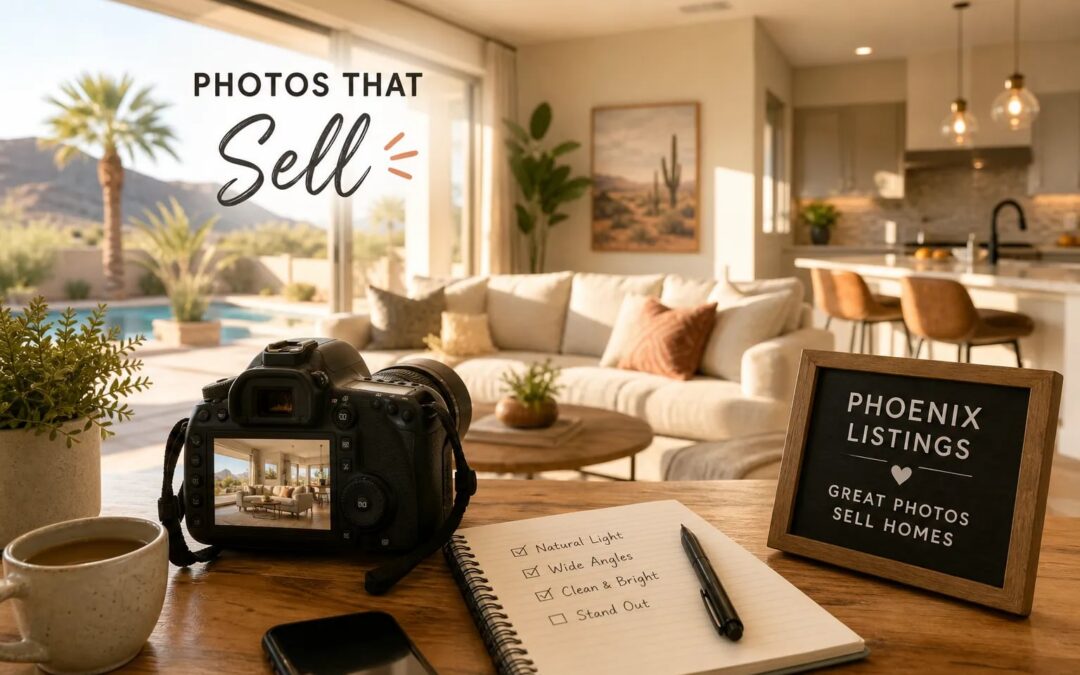
Phoenix listing photos are the first thing buyers see, and often the only thing that determines whether a property gets a showing or gets skipped. In a market this competitive, your images are doing the selling before any agent, price point, or neighborhood description enters the picture. From low-profile ranch homes in Peoria to desert modern builds in North Scottsdale, how a property photographs shapes how quickly it moves and what it ultimately sells for.
Phoenix’s market doesn’t give you much margin for error. Listings gain traction within the first 24 to 48 hours of going live, and a weak photo set squanders that critical window. That’s why understanding what quality listing photography actually costs, which add-ons move the needle, and how to prepare a property before the shoot matters so much for agents competing across the metro.
This article walks through all of it: realistic pricing, the add-ons worth budgeting for, how Listing Marketing Pros packages everything into a single one-business-day delivery, and the pre-shoot checklist that helps every shot land on MLS the way it should.
Why Phoenix listing photos directly affect your days on market
The numbers behind the click
Homes listed with professional photography sell approximately 32% faster than those shot on a phone or with amateur equipment, according to Phoenix-area marketing reports. Add drone imagery to the mix and the numbers get more dramatic: listings with aerial shots receive up to 94% more views and are 65% more likely to generate in-person showing requests. These aren’t national abstractions applied loosely to Arizona; Phoenix real estate agents who track their listing analytics consistently see engagement spike when photo quality is high. High-quality images directly impact buyer behavior, conversion rates, and how properties rank on listing platforms, which is why professional photography consistently outperforms amateur shots.
Buyers filter visually before they ever contact an agent. The photo is effectively the first showing, and it happens silently, on a phone screen, while someone is scrolling during lunch. If the images don’t stop the thumb, the listing doesn’t get a second look, regardless of how well-priced or well-located the home actually is.
How Phoenix’s home styles shape the shot
Shooting Phoenix properties well requires more than a quality camera. A sprawling ranch home in Glendale benefits from wide-angle exterior shots that capture the full roofline, the xeriscaped front yard, and the depth of the lot, framing choices that require understanding how buyers evaluate single-story layouts. A desert modern build in Paradise Valley needs elevated framing and clean geometric composition that showcases the architecture and its relationship to the site.
Phoenix’s light conditions add another layer. Midday sun in July creates harsh shadows and blown-out skies that flatten even beautiful properties. Golden-hour windows, roughly an hour after sunrise or before sunset, produce the warm, directional light that makes exterior shots sing. Photographers who’ve spent years shooting across the Valley know how to work those windows and how to manage the intense ambient light indoors without losing the bright, airy feel buyers expect from desert homes.
What Phoenix listing photography actually costs
The $150 to $450 spectrum
Phoenix real estate photography generally falls into three tiers. Professional real estate photography packages in the $125, $200 range typically include HDR-edited photos in MLS-ready format with standard turnaround. Mid-range packages running $200, $300 add a 2D floor plan, a listing website, and next-business-day delivery, which is where most residential listings in the Phoenix metro find their sweet spot. Higher-end packages at $300, $450 or above layer in drone aerial shots, twilight images, and 3D virtual tours for properties where those add-ons justify the investment.
Some providers in the Valley price by square footage, which can make budgeting predictable for agents managing multiple listings at different price points. Others bundle core deliverables and charge separately for every add-on, which makes the initial quote look lower than the final invoice.
What you sacrifice by going budget
A basic photo package gets you edited images and not much else. No floor plan, no aerial context, no virtual staging option, and often longer delivery windows, sometimes more than 24, 48 hours, that eat into the critical first day of listing traction. In a market where serious buyers refresh new listings daily, losing that initial visibility window has a real impact on showing count during the first week.
Some budget providers also charge separately for things that reputable integrated services bundle into a single package: floor plans, social media assets, the listing website, and the print flyer that helps you win the appointment in the first place. The true cost comparison only makes sense when you add up all the line items.
Which add-ons are actually worth the investment
Drone and aerial photography
Aerial shots work hardest on Phoenix listing photos where lot context matters: pool placement relative to the yard, mountain view corridors, proximity to a golf course, or a cul-de-sac location that’s hard to appreciate from street level. These are the details that motivate buyers to schedule a showing rather than stay curious from a distance. For properties with any of those features, drone imagery isn’t an upsell, it’s the shot that explains why the home is priced the way it is.
One non-negotiable: the drone operator must hold an FAA Part 107 certification for commercial real estate work. This isn’t optional, and agents should confirm compliance before any aerial work gets booked. Using an unlicensed operator creates liability and can put deliverables at risk if footage needs to be pulled. When evaluating listing photography packages in Phoenix, ask about Part 107 credentials upfront.
Twilight, virtual staging, and 3D tours
Twilight photography performs differently depending on the home style. Desert modern properties often benefit from a dusk shoot: the blue-hour sky, warm interior glow, pool illumination, and fire features against the Arizona horizon create images that are genuinely hard to scroll past. Ranch homes benefit when they have strong exterior lighting and curb appeal; simpler facades without landscape lighting often read better in a clean daytime shot that shows the layout clearly.
Virtual staging is a practical tool for vacant listings. Local Phoenix agents report shorter days on market on virtually staged properties compared to empty-room photos, and the cost is a fraction of physical staging. For 3D tours, Matterport and Zillow 3D both increase time spent on a listing page and help buyers self-qualify before booking a showing, which means agents field more serious inquiries and fewer curiosity walkthroughs.
How Listing Marketing Pros delivers more than just photos
One booking, one business day, everything live
Listing Marketing Pros was built specifically for Phoenix agents who need to go live fast without coordinating five separate vendors. One booking delivers magazine-quality HDR photos, a 2D floor plan, a single property website, a print flyer, social media reels and posts, and a Zillow 3D tour, all within one business day of the shoot. That kind of turnaround eliminates the gap between “photos done” and “listing live” that costs agents real momentum in the first 48 hours.
Pay-at-closing options are available for agents managing cash flow across multiple active listings, and listing presentation flyers come included so you can walk into the appointment already showing the seller what their marketing will look like. For agents who want to win the listing before the photos even happen, that flyer is a tangible differentiator at the table.
Why local experience changes the quality of the output
Deep familiarity with Phoenix-area properties means the Listing Marketing Pros team understands how to work around midday sun, how to frame desert modern architecture, and how to make a compact Peoria ranch read as spacious and inviting on a 6-inch phone screen. That local knowledge is built into every shoot, not improvised on site. The team serves agents across Phoenix, Surprise, Glendale, Peoria, Goodyear, Buckeye, and the broader West Valley corridor.
FAA-certified drone pilots, Matterport 3D capability, virtual staging, and twilight photography are all handled under one roof. That means every deliverable shares a consistent editing style rather than looking like it came from three different photographers with three different color preferences, which is exactly what happens when agents stitch together multiple vendors per listing.
How to prep your Phoenix listing photos: a pre-shoot checklist
Interior and exterior prep that makes a real difference
The photography appointment is not the time to discover that the master bath has six personal care products on the counter and a towel on the floor. Interior prep should happen the day before: remove personal photos and countertop clutter, stage towels and bedding so they look intentional, confirm all light bulbs are working and match in color temperature within each room, and pull vehicles out of the garage and driveway. Window treatments matter too, partially open blinds let Phoenix’s natural light flood a room without the overexposed wash that fully open blinds can cause. Follow a detailed pre-shoot checklist to ensure nothing gets overlooked before your photographer arrives.
Exterior prep is just as important, because the front elevation is typically the primary MLS photo. Trim desert landscaping so it looks maintained rather than wild, clean pool water and tile lines, sweep patios, and arrange outdoor furniture symmetrically. Trash bins, garden hoses, and any equipment staged near the entry should be out of frame entirely. First impressions start at the curb, and that exterior hero shot sets the visual tone for every room photo that follows.
ARMLS specifications every agent should know
ARMLS accepts listing photos in several formats, including JPEG, PNG, TIFF, and BMP, and requires landscape orientation, a minimum of 1,024 pixels on the longest side, and a maximum file size of 15 MB (or 2,000 x 3,000 pixels). Per ARMLS Rule 8.23, no branding, watermarks, logos, or contact information can be embedded in the image. For residential listings, at least one front exterior photo must be added within four days of the listing going active.
A reputable Phoenix listing photography service will deliver files pre-formatted to meet these specifications, so you can upload directly to ARMLS without resizing, converting, or stripping metadata. If your photographer is handing you files that need additional processing before upload, that’s a workflow gap that adds unnecessary friction to every single listing.
The bottom line on Phoenix listing photos
Investing in professional listing photography isn’t a marketing line item you can trim without consequences, it’s a selling strategy with measurable results. Better phoenix listing photos generate more clicks, more showings, and fewer days on market. The right add-ons (drone for lot-dependent properties, twilight for desert modern homes, virtual staging for vacant listings) amplify that effect when they match the property type. And prepping the home correctly before the shoot ensures nothing is wasted at the moment the shutter fires.
For agents across the Phoenix metro who want all of that handled in a single booking, Listing Marketing Pros delivers the complete package, photos, floor plan, drone imagery, 3D tour, social media content, flyer, and listing website, within one business day. No juggling vendors, no chasing deliverables, no delay before you go live.
Ready to improve your Phoenix listing photos? Book a shoot with Listing Marketing Pros today, or request your free Listing Marketing Report Card to identify missed opportunities on your current listings.